How to Scope a Software Project (5-Stage Method)
You scope a software project in five steps. Take the client's raw requirements. Analyze them for gaps and hidden assumptions. Turn what survives into a functional specification. Break that spec into a work breakdown structure with effort attached to every task. Summarize the total into an estimate you can defend.
That is the method. Everything below is what each step actually looks like, with a real example.
The Five Stages, Fast
Most scoping guides skip straight to the work breakdown structure. That is a mistake. A WBS built on bad requirements is just a detailed wrong answer.
The order matters:
- Requirements — what the client says they want.
- Requirement Analysis — what they actually need, once you find the gaps.
- Functional Specification — the analyzed requirements, turned into named features.
- Work Breakdown — the spec, broken into tasks with effort attached.
- Summary — the total effort, mapped to your rates, into a number you can defend.
Skip a stage and the next one inherits its errors. A missed requirement in stage one becomes a missing feature in stage three and a scope-change email in month two.
Prophic is an AI-powered pre-sales platform for agencies, consultancies, and freelancers. It turns raw client requirements into a scoped work breakdown, effort estimate, and branded proposal in minutes.
Stage 1: Requirements
A client sends you this: "We need a booking app for our yoga studio. Customers should be able to book classes online."
That is a requirement. It is also nowhere near enough to scope.
At this stage, your only job is to collect what the client says, word for word, without editing it into something more polished than it is. Do not fill gaps yet. Do not assume. If the brief says "book classes," write down "book classes" and move on. The gaps get handled in the next stage, on purpose, separately.
Most scoping mistakes happen because someone skips straight from this raw brief to a task list. The brief above contains one sentence. A yoga studio booking app is not one sentence of work.
Stage 2: Requirement Analysis
Now you interrogate the brief.
"Book classes online" raises questions the client did not think to answer. What happens when a class is full? Is there a waitlist? Can a customer cancel, and how many hours before class does that stop being free? Does the studio run one location or five, and do class schedules differ by location? What timezone does a customer see if they book from another city?
None of that was in the original brief. All of it changes the size of the build.
This is the stage that separates a real scoping process from a guess. You are not adding features the client did not ask for. You are surfacing decisions the client has to make before anyone can price the work. A studio with one location and no waitlist is a different project than a five-location studio with a waitlist and cancellation windows. Both are technically "a booking app." They are not the same job.
Write these gaps down as open questions. Send them back to the client, or make defensible assumptions and log them. Either way, this is where under-estimation gets caught before it becomes a change order.
Stage 3: Functional Specification
With the gaps closed, the vague brief becomes a list of named, buildable features.
"Book classes online" becomes: a class calendar view, a booking flow with capacity checks, a waitlist queue with automatic promotion when a spot opens, a cancellation flow with a configurable cutoff window, and a timezone-aware schedule display. Each of those needs a screen, a set of states, and a role: customer, studio staff, or admin.
This is the point where a client can look at the document and recognize their own business in it. Not "a booking system." Their booking system, with their edge cases named.
A functional spec that still uses words like "handle bookings" has not done its job. "Handle" is not a feature. "Show remaining capacity and block booking past it" is.
Stage 4: Work Breakdown
This is where the spec turns into a number.
Every feature in the functional spec becomes a task. The class calendar view is a task. The waitlist queue is a task. Each task gets an effort estimate, and each estimate carries its own complexity, because "build a login screen" and "build a waitlist with automatic promotion logic" are not the same size of task even though they are both one line in a feature list.
The useful version of this is not a flat list. It is a tree. The booking app becomes: Customer-Facing Booking (calendar, booking flow, waitlist, cancellation), Studio Admin (schedule management, capacity settings, cancellation policy config), and Notifications (booking confirmation, waitlist promotion alert, cancellation confirmation). Each branch expands into tasks. Each task carries a complexity rating and an hour estimate. You can look at any node and see exactly what is driving the total.
This is also where scope creep gets caught before the contract is signed, not during week six of the build [How to prevent scope creep]. If the client later asks "can we also support recurring class packages," you point at the tree and show them it is not there. That is a change order conversation, not an argument.
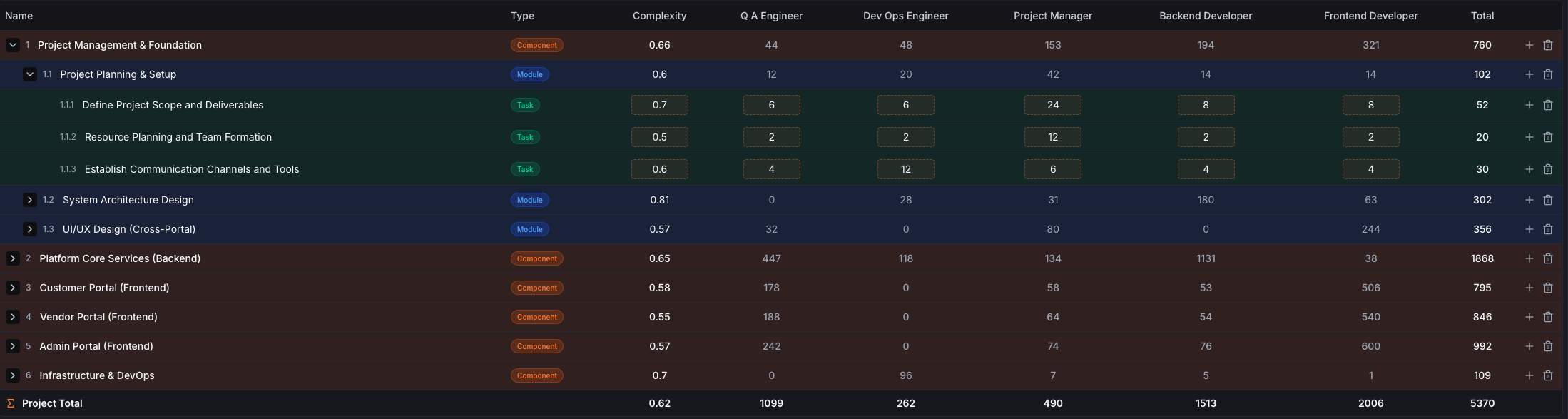
Building this tree by hand from a messy client email takes hours, and most agencies do it from memory instead of from the actual brief, which is how requirements get lost. Prophic reads the raw brief, asks the clarifying questions from stage two, and builds this tree for you, with complexity already scored per node. Or you keep doing it by hand. Either way, the method above is what has to happen before you can price anything.
Stage 5: Summary
The work breakdown gives you total hours. Multiply by your rates, by role, and you have an estimate.
This is also where you stop. The proposal document, the pricing presentation, the client-facing polish — that is a separate job, built on top of this estimate, not part of scoping it. Scoping ends at a number you can defend line by line. What you do with that number afterward depends on your process, your margins, and how you sell.
A defensible estimate looks like this: not "the booking app will cost $40,000," but "here are 34 tasks, here is the complexity rating on each, here is the hourly rate, here is the total." A client can argue with a lump sum. It is much harder to argue with a tree they can see into.
Frequently Asked Questions
What is the difference between a work breakdown structure and a proposal?
A work breakdown structure is the internal scoping document: tasks, complexity, and effort hours, built from the client's requirements. A proposal is the client-facing document built from the WBS, with pricing, terms, and branding added. The WBS answers "what is the work." The proposal answers "what do you pay and when."
How long should scoping a software project take?
It depends on the size of the brief and how many gaps stage two surfaces. A one-page brief with a clear feature set can move through all five stages in under a day. A brief with many open questions, several stakeholders, or an unclear scope boundary can take longer, because stage two is doing real work, not just formatting.
Do I need a functional specification for a small project?
Yes, even a short one. A functional spec does not need to be long. It needs to name every feature the work breakdown will later estimate. Skipping it means the work breakdown is built on the original vague brief instead of the analyzed one, and the gaps from stage one carry straight through to the estimate.
What causes scope creep after a project starts?
Usually a requirement that was never analyzed in stage two. If "book classes online" was priced without asking about waitlists, and the client assumed waitlists were included, that gap surfaces mid-project as a dispute instead of a documented decision made before the contract was signed [Handling Vague Client Requirements].
Turn a brief into a scoped proposal → Book a Demo